

|
||
|---|---|---|
click to enlarge |
||
|
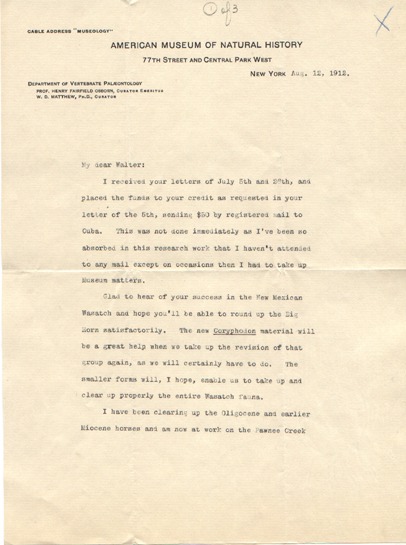
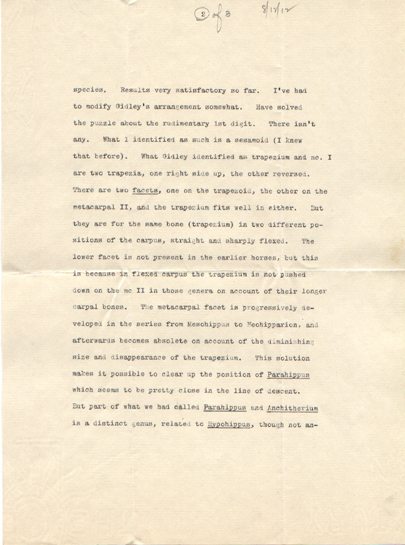
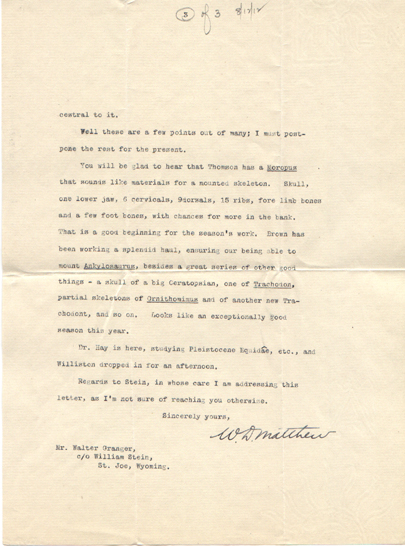
My dear Walter: I received your letter of July 5th and 25th, and placed the funds to your credit as requested in your letter of the 5th, sending $50 by registered mail to Cuba. This was not done immediately as I've been so absorbed in this research work that I haven't attended to any mail except on occasions then I had to take up Museum matters. Glad to hear of your success in the New Mexican Wasatch and hope you'll be able to round up the Big Horn satisfactorily. The new Coryphodon material will be a great help when we take up the revision of that group again, as we will certainly have to do. The smaller forms will, I hope, enable us to take up and clear up properly the entire Wasatch fauna. I have been clearing up the Oligocene and earlier Miocene horses and am now at work on the Pawnee Creek species. Results very satisfactory so far. I've had to modify Gidley's arrangement somewhat. Have solved the puzzle about the rudimentary 1st digit. There isn't any. What I identified as such is a sesamoid (I knew that before). What Gidley identified as trapezium and me. I are two trapezia, one right side up, the other reversed. There are two facets, one on the trapezoid, and the other on the metacarpal II and the trapezium fits well in either. But they are for the same bone (trapezium) in two different positions of the carpus, straight and sharply flexed. The lower facet is not present in the earlier horses, but this is because in flexed carpus the trapezium is not pushed down on the mc II in those genera on account of their longer carpal bones. The metacarpal facet is progressively developed in the series from Meaohippus to Neohipparion, and afterwards becomes absolute on account of the diminishing size and disappearance of the trapezium. This solution makes it possible to clear up the position of Parahippus, which seems to be pretty close in the line of descent. But part of what we had called Parahippus and Anchiterium is a distinct genus, related to Hypohippus, though not ancestral to it. Well these are a few points out of many; I must postpone the rest for the present. You will be glade to hear that Thomson has a Noropus that sounds like materials for a mounted skeleton. Skull, one lower jaw, 6 cervicals, 9 dorsals, 15 ribs, fore limb bones and a few foot bones, with chances for more in the bank. That is a good beginning for the season's work. Brown has been working a splendid haul, ensuring our being able to mount Ankylosaurus, besides a great series of other good things - a skull of a big Ceratopsian, one of Trachodon, partial skeletons of Ornithomimus and of another new Trachodont, and so on. Looks like an exceptionally good season this year. Dr. Hay is here, studying Pleistocene Equidae, etc., and Williston dropped in for an afternoon. Regards to Stein, in whose care I am addressing this letter, as I'm not sure of reaching you otherwise. Sincerely yours, W. D. Matthew Mr. Walter Granger, c/o William Stein, St. Joe, Wyoming. |
||
| BACK (1912-AUG-08) | NEXT (1912-AUG-16) | |