(Female redundant descriptions removed)
Gradunguloonops florezi
Get publication
Male (PBI_OON 43165). Total length 1.86. CEPHALOTHORAX: Eyes on dark pigment. Endites with a lateral furrow that bisects the maxilla in two sections: a dorsal one, flattened, bearing the serrula, and a ventral one, thickened, with a truncated, less sclerotized tip. LEGS: Leg spination (only surfaces bearing spines listed, all spines longer than segment width): (leg II: femora: d1, leg III: tibiae: r0-0-1;
metatarsi: d0-1-0, r0-0-1, p1-0-1, leg IV: tibiae: d0-0-1-0, r1-1, p1-1;
metatarsi: d1-0-1, r1-1, p1-1. ). Tarsi I to IV superior claws tooth not examined in detail. Trichobothria not examined. GENITALIA: Palp embolus curved upwards and prolaterally, with a wide opening accompanyied by a strong hook; bulb distal part prolateral conductor reduced to a small, blunt protuberance.
Gradunguloonops florezi, male habitus, dorsal view (image by XG, specimen ID: ---43165)
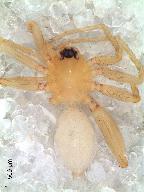
Gradufloremphabd43165XG.tif
| Gradunguloonops florezi, male habitus, ventral view (image by XG, specimen ID: ---43165)
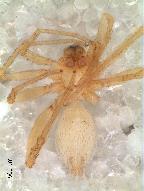
Gradufloremphabv43165XG.tif
| Gradunguloonops florezi, male habitus, lateral view (image by XG, specimen ID: ---43165)
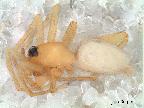
Gradufloremphabl43165XG.tif
| Gradunguloonops florezi, male carapace, dorsal view (image by XG, specimen ID: ---43165)
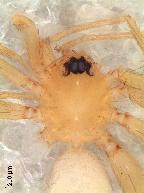
Graduflorempcard43165XG.tif
| Gradunguloonops florezi, male carapace, lateral view (image by XG, specimen ID: ---43165)
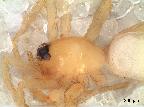
Graduflorempcarl43165XG.tif
| Gradunguloonops florezi, male carapace, anterior view (image by XG, specimen ID: ---43165)
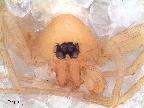
Graduflorempcara43165XG.tif
| Gradunguloonops florezi, male palp, prolateral view (image by XG, specimen ID: ---43165)
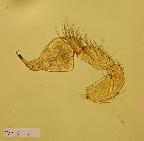
Gradufloremppalp43165XG.tif
| Gradunguloonops florezi, male palp, dorsal view (image by XG, specimen ID: ---43165)
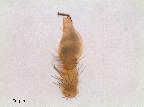
Gradufloremppald43165XG.tif
| Gradunguloonops florezi, male palp, retrolateral view (image by XG, specimen ID: ---43165)
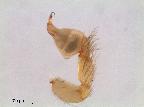
Gradufloremppalr43165XG.tif
| Gradunguloonops florezi, male palp, prolateral view (image by XG, specimen ID: ---43165)
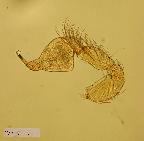
Gradufloremppalp43165XG.jpg
| Gradunguloonops florezi, male embolus, prolateral view (image by XG, specimen ID: ---43165)
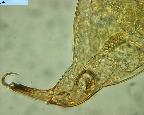
Graduflorempembp43165XG.jpg
| Gradunguloonops florezi, male palp, prolateral view (image by XG, specimen ID: ---43165)

Gradufloremdpalp43165XG.tif
|
Female (PBI_OON 43165). Total length 1.90. As in male except as noted. CEPHALOTHORAX: Eyes on dark pigment. Female palp spines absent. LEGS: femora femur IV slightly thicker than I-III. Leg spination (only surfaces bearing spines listed, all spines longer than segment width): (leg III: femora: d1ap;
tibiae: d1, p1-1, r1-1, v1-1ap;
metatarsi: p1ap, d1-1ap, r1-1ap, leg IV: femora: d1-4ap;
tibiae: p1-1, r1-0-1, v1-2ap;
metatarsi: p1ap, d1-1ap, r1-1ap. ). Tarsi I to IV superior claws tooth not examined in detail. Trichobothria not examined. GENITALIA: Ventral view: anterior receptacle with two elements, a ventral, solid, T-shaped that serves as muscle attachment, and other dorsal, with thickened walls and gland tissue; with a narrow anterior projection (with a dorsal, sac-like, membranous vesicle)and a basal, globular part. Two short, curved, transverse ridges connected between them above the base of the anterior receptacle. The widened endings of the transverse bars don´t reach to the lateral apodemas of the posterior, procurved bar. Posterior receptacle relatively small, wider than long..
Gradunguloonops florezi, female epigynum, epigynal area, ventral view (image by XG, specimen ID: ---43165)
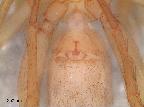
Graduflorefpepiv43165XG.tif
| Gradunguloonops florezi, female habitus, dorsal view (image by XG, specimen ID: ---43165)
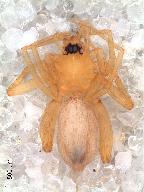
Graduflorefphabd43165XG.tif
| Gradunguloonops florezi, female habitus, ventral view (image by XG, specimen ID: ---43165)
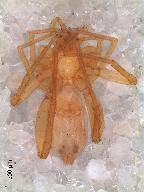
Graduflorefphabv43165XG.tif
| Gradunguloonops florezi, female habitus, lateral view (image by XG, specimen ID: ---43165)
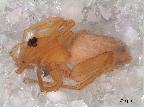
Graduflorefphabl43165XG.tif
| Gradunguloonops florezi, female carapace, dorsal view (image by XG, specimen ID: ---43165)
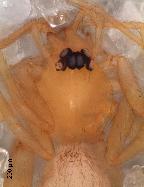
Graduflorefpcard43165XG.tif
| Gradunguloonops florezi, female carapace, ventral view (image by XG, specimen ID: ---43165)
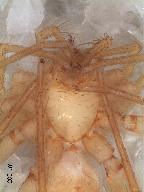
Graduflorefpcarv43165XG.tif
| Gradunguloonops florezi, female carapace, lateral view (image by XG, specimen ID: ---43165)
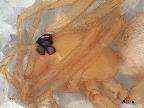
Graduflorefpcarl43165XG.tif
| Gradunguloonops florezi, female carapace, anterior view (image by XG, specimen ID: ---43165)
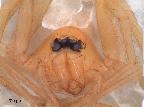
Graduflorefpcara43165XG.tif
| Gradunguloonops florezi, female internal female genitalia, dorsal view (image by XG, specimen ID: ---43165)
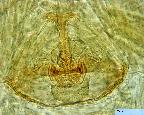
Graduflorefpifgd43165XG.jpg
| Gradunguloonops florezi, female internal female genitalia, dorsal view (image by XG, specimen ID: ---43165)

Graduflorefdifgd43165XG.tif
|
| |
DISTRIBUTION

COLOMBIA
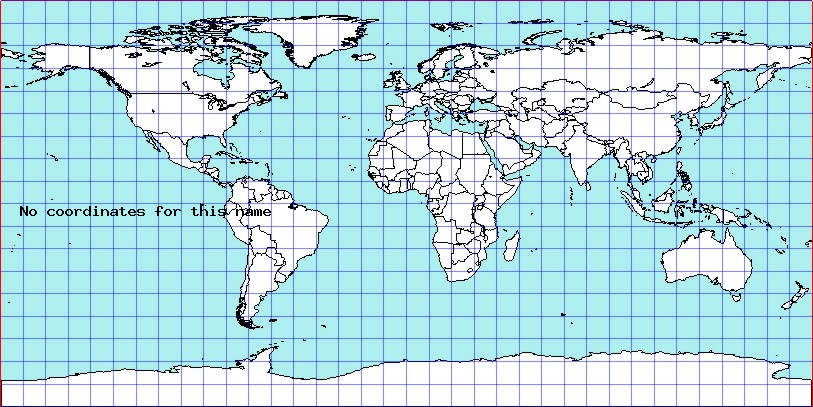
Click the following link for a map from Discover Life which displays the records below.
You can click anywhere on that map to zoom in, and clicking on any point will display the full data for that locality
Gradunguloonops florezi, Discover Life Map
|
|
|
|
MATERIAL EXAMINED
|
| PBI USI |
Country |
State |
Division |
Locality |
Sex |
Type Status |
Elevation(m) |
GPS Coordinate |
Habitat |
Collection_Date |
Collector |
Inst. Code |
| PBI_OON 00043165 |
COLOMBIA |
Amazonas |
|
Leticia, IMANI Est. |
2 Adult Female |
Paratype |
|
; |
|
12 Nov 2001 |
Eduardo Flórez |
ICN |
| PBI_OON 00043165 |
COLOMBIA |
Amazonas |
|
Leticia, IMANI Est. |
1 Adult Male |
Holotype |
|
; |
|
12 Nov 2001 |
Eduardo Flórez |
ICN |
|
|
|

 |
| |
|

)
)
)