| Advanced Ecology –
Biology 45500 Climate Change Biology |
Fall 2013 with RF Rockwell |
![]() |
| This course meets in a secure area of the American Museum of Natural History. Until I can arrange access for each student, please go to the Security Desk at the Central Park West entrance (1st floor beneath the steps) no later than 12:15. We will meet you there and go to the classroom. Thanks! |
|
This advanced ecology course will center on Climate Change Biology. We will examine the underlying principles of climate dynamics. We will consider the physical evidence for climate change and assess how human activities may be related to such change. We will then explore the potential impact such change is having on biological systems. This will include effects on the ranges and phenologies of species as well as general ecosystem functioning. As a backdrop for current change, we will explore historic climate impacts including the major earth extinction events. Armed with past and current evidence, we will examine what the future may hold and how we might alter that future. The latter will
include an objective assessment of the potential impacts of new solutions to
old problems (e.g. Is producing and burning ethanol better for the global
ecosystem than burning oil? Are wind farms really green?). Finally we will examine the social implications
of such change both locally and globally. The primary text for the course is Lee J.
Hannah. 2011. Climate Change Biology. Academic Press, The prerequisites for the course are: Bio
22800 and Math 20900.
|
| Lecture Schedule and Readings |
| week | date | topic | reading |
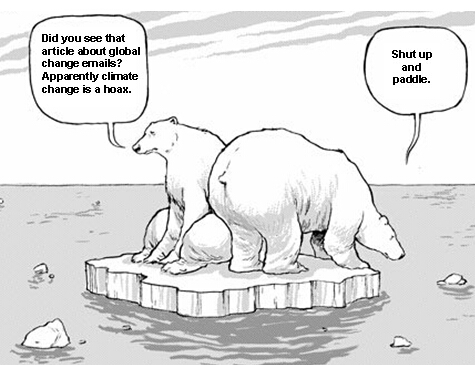
| 1 | 08/28/13 | The early bear gets the goose | rockwell & company 2009,2011 |
| 2 | 09/04/13 | no class | |
| 3 | 09/11/13 | Climate systems and climate change | Hannah 1-2 |
| 4 | 09/18/13 | Species and range shifts; phenology shifts and mismatches | Hannah 3-4 |
| 5 | 09/25/13 | Ecosystem changes | Hannah 5 |
| 6 | 10/02/13 | Past changes in terrestrial and marine ecosystems | Hannah 6-7 |
| 7 | 10/09/13 | Past changes in fresh water ecosystems; Extinctions | Hannah 8-9 |
| 8 | 10/16/13 | Insights from experiments | Hannah 10 |
| 9 | 10/23/13 | Modeling responses and estimating extinction risk | Hannah 11-12 |
| 10 | 10/30/13 | Implications for conservation | Hannah 13-15 |
| 11 | 11/06/13 | Finding solutions | Hannah 16-18 |
| 12 | 11/13/13 | Written Exam | |
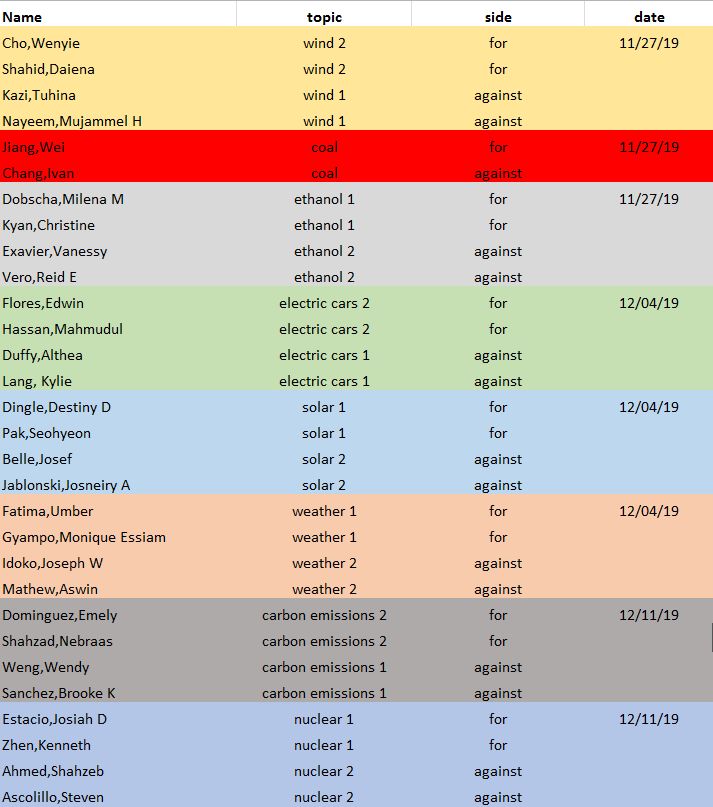
| 13 | 11/20/13 | The Great Debates | |
| 14 | 11/27/13 | Turkey Day - no class | |
| 15 | 12/04/13 | The Great Debates | |
| 16 | 12/11/13 | The Great Debates |
| Readings for the course |
| Rockwell, RF and LJ Gormezano. 2009. The early bear gets the goose: climate change, polar bears and lesser snow geese in western Hudson Bay. Polar Biology 32:539-547. |
| Rockwell, RF, LJ Gormezano and DN Koons. 2011. Trophic matches and mismatches: Can polar bears reduce the abundance of nesting snow geese in western Hudson Bay? Oikos 120:696-709. |
| Lee J. Hannah. 2011. Climate Change Biology. Academic Press, Burlington, MA. |
| Your grade in the course is based on the written exam (40%) and your participation in the Great Debates (60% total). In the Great Debates you and a partner will debate a topic against another 2-person team. You and your partner will be graded based on your preparation and presentation (see below) and that will count for 40% of your course grade. The remaining 20% of your grade will come from your participation in the other debates (see below). The Great Debates will be based on topics listed below. For a given topic one team will prepare to defend the position given in the topic while the other will prepare to refute it. The defending team gets 15 minutes to make its case and the opposing team will get 15 minutes to refute it. Starting wit the defending team, each team is given 5 minutes to challenge the opposition. The debate is then opened to the class and everyone can both ask questions and challenge views presented. You will be graded on your informed participation. The debate propositions (topics) are: 1. Global temperature is increasing. 2. Carbon emissions are causing climate change. 3. Ethanol production will reduce our carbon footrint. 4. Increased use of electric cars is a safe way to reduce our carbon footprint. 5. Wind power is an ecologically safe way to reduce our carbon footprint. 6. The increase in extreme weather events is the result of global climate change. |
| last revised 05/18/13 |