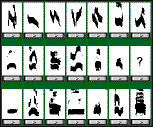

Description: These special calls are toop-like in overall structure. Sonograms of many crossbills (except most Type 1 birds) show extensive harmonics in their alarm notes. Within each crossbill species, alarm calls and toops differ in pattern of frequency modulation, amplitude, and pitch (alarm calls tend to be softer and deeper). Alarm calls are also given at relatively slow cadence (~1 per second) or may be uttered only once by a bird after it is alarmed.
A noisy flock of crossbills becomes hushed when one bird begins a series of alarm calls. Birds become less mobilized and scan the air. I have had caged crossbills give this call while they were traveling in the back of a covered pickup truck going 50 mph. If I would search out the windows, I usually found a large bird nearby, such as a flying hawk or a kestrel on a wire.
Banders and researchers note: this call is commonly given by crossbills held in the hand after removal from mist nets (birds generally do not give the call while they are in the net). Workers might hold tape recorders near birds while they are banded and measured. These calls are diagnostically different among the various crossbill species.