

|
||
|---|---|---|
click to enlarge |
||
|
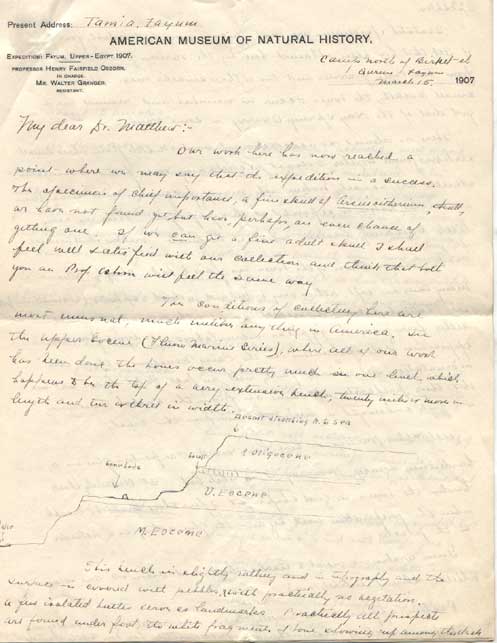
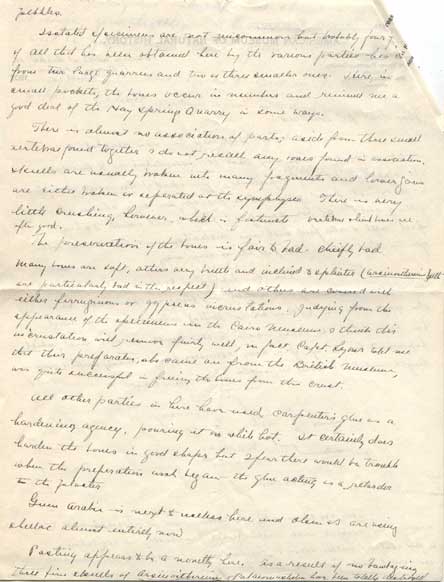
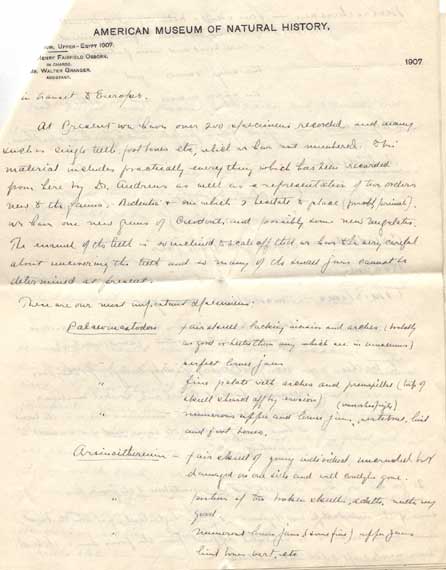
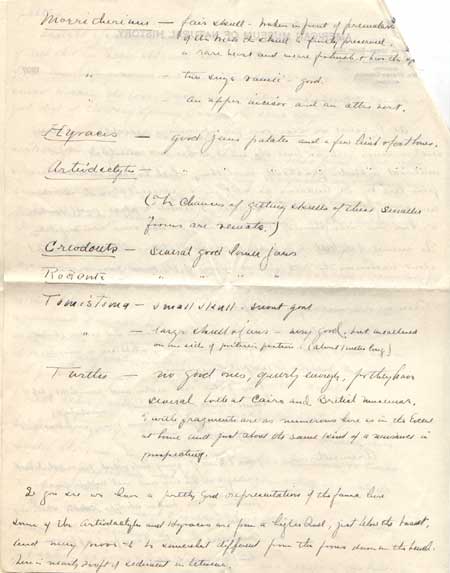
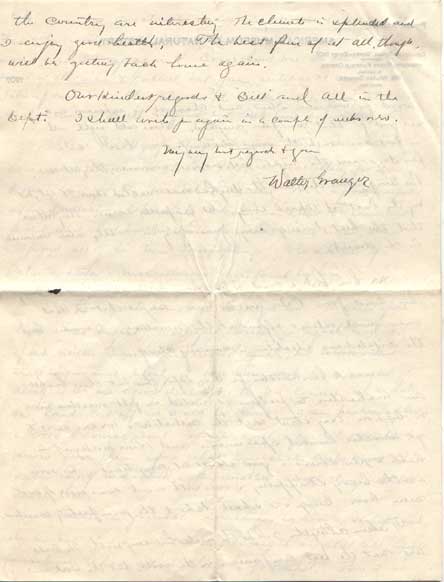
March 15 1907 My dear Dr. Matthew:- Our work here has now reached a point where we may say that the expedition is a success. The specimens of chief importance, a fine skull of Arsinoitherium we have not found yet, but have, perhaps, an even chance of getting one. If we can get a fine adult skull I should feel well satisfied with our collection and think that both you and Prof. Osborn will feel the same way. The conditions of collecting here are most unusual, much unlike anything in America, see the upper Eocene (Fluou Marine Series), where all of our work has been done, the bones occur pretty much in one level which happens to be the top of a very extensive trench, twenty miles or more in length and two or three in width. This trench is slightly rolling in topography and the surface is covered with pebbles & with practically no vegetation. A few isolated buttes serve as landmarks. Practically all prospects are found underfoot, the white fragments of bone showing up among the dark pebbles. Isolated specimens are not uncommon but notably four of all that has been obtained here by the various parties from two large quarries and two or three smaller ones. There, in small pickets, the bones occur in numbers and remind me a great deal of the Hay Springs Quarry in some ways. There is almost no association of parts; aside from three small vertebrae found together I do not recall any bones found in association. Skulls are usually broken into many fragments and lower jaws are either broken or separated at the symplyses. There is very little crushing, however, which is fortunate. Vertebrae & hind bones are often good. The preservation of the bones is fair to bad. Chiefly bad. Many bones are soft, others very brittle and inclined to splinter (Arsinoitherium teeth are particularly bad in this respect) and others are covered with either ferruginous or gypseus incrustations. Judging from the appearance of the specimens in the Cairo Museum I think this incrustation will remove fairly well, in fact. Capt. Lyons told me that their preparation, who came in from the British Museum, was quite unsuccessful in freeing the bones from the crust. All other parties in here have used carpenters' glue as a hardening agency, pouring it on while hot. It certainly does harden the bones in good shape but I fear there would be trouble when the preparation work began - the glue acting as a retarder to the plaster. Gum arabic is next to useless here and Olsen & I are using shellac almost entirely now. Pasting appears to be a novelty here. As a result of no bandaging three fine skulls of Arsinoitherium & Palaeomastodon have been totally destroyed in transit to Europe. At present we have over 200 specimens recorded and many such as single teeth, footbones etc., which we have not numbered. This material includes practically everything which has been recorded from here by Dr. Andrews as well as a representation of two orders new to the fauna, Rodentia and am which I hesitate to place (possibly primate). We have one new genus of Creudont and possibly some new Ungulates. The enamel of two teeth is so inclined to scale off that we have to be very careful about uncovering the teeth and so many of the small jaws cannot be determined at present. These are our most important specimens:
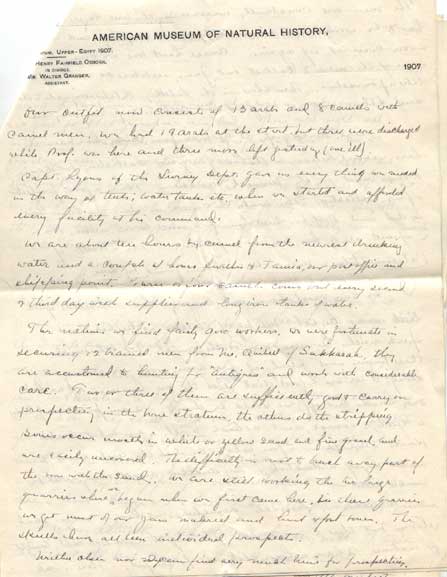
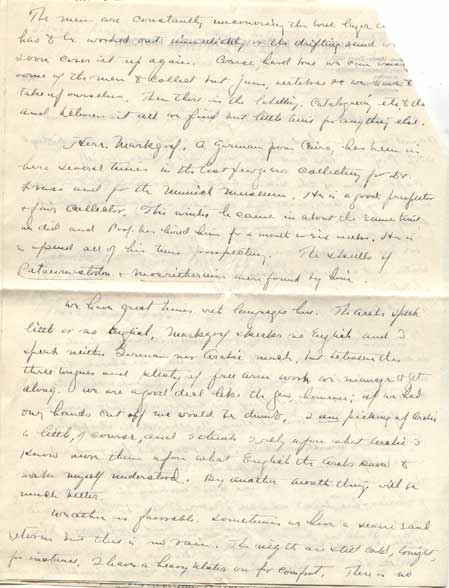
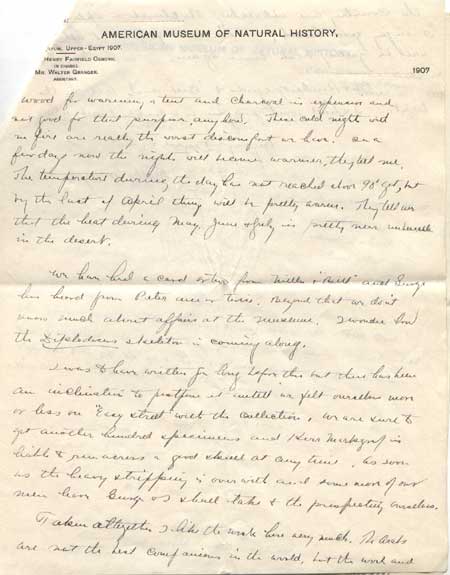
So you see we have a pretty good representation of the fauna here. Some of the Artiodactyls and Hyracus are from a higher hill, just below the (?), and may prove to be somewhat different from the forms down in the trench. There is nearly 200ft. of sediment in between. Our outfit now consists of 13 Arabs and 8 camels with camel men. We had 19 Arabs at the start, but three were discharged while Prof. was here and three more left yesterday (one ill). Capt. Lyons of the Survey Dept. gave us everything we needed in the way of tents, watertanks etc. when we started and afforded every facility at his command. We are about ten hours by camel from the nearest drinking water and a couple of hours further of Tamia, our post office and shipping point. Three or four camels come out every second or third day with supplies and long iron tanks of water. The natives we find fairly good workers. We were fortunate in securing 12 trained men from Mr. Quihell of Sakkarah, they are accustomed to hunting for "antiques" and work with considerable care. Two or three of them are sufficiently good and carry on prospecting in the low stratum, the actives do the stripping. Bones occur mostly in white or yellow sand and fine gravel and are easily uncovered. The difficulty is not to brush away part of the bone with the sand. We are still working the two large quarries where we began when we first came here. In these quarries we get most of our jaw material and hind and foot bones. The skulls have all been individual prospects. Neither Olsen nor (?) find any much time for prospecting. The men are constantly uncovering the lone layer that has to be worked out immediately or the drifting sand will soon cover it up again. Coarse, hard bones we can trust some of the men to collect but jaws, vertebrae etc. we have to take up ourselves. Then there is the labelling, cataloguing etc. to do in between it all we find but little time for anything else. Herr Markgraf, a German from Cairo, has been in here several times in the last few years collecting for Dr. Grass and for the Munich museum. He is a good prospector and fair collector. This winter he came in about the same time we did and Prof. has hired him for a month or six weeks. He is to spend all of his time prospecting. The skulls of Pataeomastodon and Moeritherium were found by him. We have great times with languages here. The Arabs speak little or no English, Markgraf speaks no English and I speak neither German nor Arabic much, but between the three tongues and plenty of free arm work we manage to get along. We are a good deal like the Jew, however; if we had our hands cut off we would be dumb. I am picking up Arabic a little, of course, and I think surely upon what Arabic I know more than upon what English the Arabs know to make myself understand. By another month things will be much better. Weather is favorable. Sometimes we have a severe sand storm but there is no rain. The nights are still cold, tonight, for instance, I have a heavy (?) on for comfort. There is no wood for warming a tent and charcoal is expensive and not good for that purpose, anyhow. These cold nights with no fire are really the worst discomfort we have. In a few days now the nights will become warmer, they tell me. The temperature during the day has not reached above 90 yet, but by the last of April things will be pretty warm. They tell us that the heat during May, June and July in the desert is pretty near unbearable in the desert. We have had a card or two from Miller and "Bill" and Surge has heard from Peter once or twice. Beyond that we don't know much about affairs at the museum. I wonder how the Diplodocus skeleton is coming along. I was to have written for long before this but there has been an inclination to postpone it until we felt ourselves more or less on "Easy Street" with the collection. We are sure to get another hundred specimens and Herr Markgraf is liable to run across a good skull at any time. As soon as the heavy stripping is over with and some more of our men leave Surge and I shall take to the prospecting ourselves. Taken altogether I lke the work here very much. The Arabs are not the best companions in the world, but the work and the country are interesting. The climate is splendid and I enjoy good health. The best fun of it all, though, will be getting back home again. Our kindest regards to "Bill" and all in the Dept. I shall write you again in a couple of weeks or so. My very best regards to you
Walter Granger |
||
| BACK (1907-MAR-11) | NEXT (1907-MAR-25) | |